
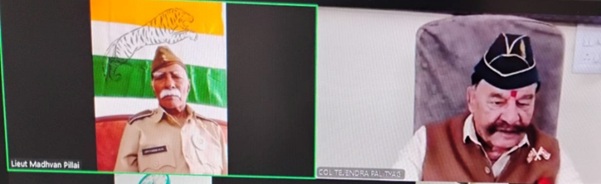
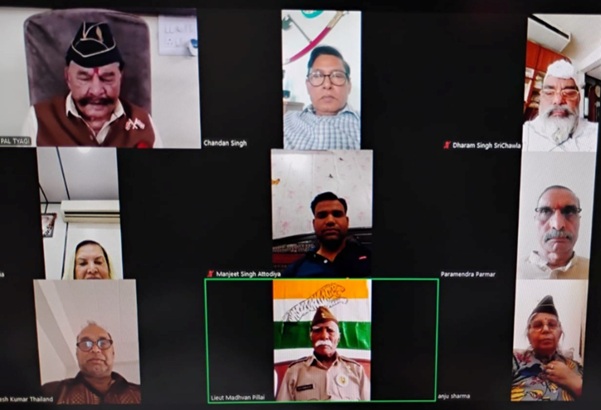
April 14, 2026 – Headquarters, Rashtriya Sainik Sanstha, 133-B Model Town East, Ghaziabad: Today, Colonel Tejendra Pal Tyagi (Vir Chakra awardee) — the National President of the Rashtriya Sainik Sanstha — held an online interaction here with 102-year-old Lieutenant Mahadevan Pillai of the Azad Hind Fauj.
Lieutenant Mahadevan Pillai served as an officer in the Azad Hind Fauj. He stated that India's independence is, primarily, the result of the valor displayed by the Azad Hind Fauj under the leadership of Netaji Subhash Chandra Bose. Netaji's courage inspired all Indians to resist and challenge British rule. The original 'Advanced Headquarters' of the Azad Hind Fauj still stands proudly in Moirang today; it has ultimately evolved into a tourist destination of international significance—a status it has always deserved.
In March 1944, three Japanese Army divisions—the 33rd, 31st, and 15th—acting in concert with the Subhash Brigade of the Azad Hind Fauj, traversed major rivers, mountain ranges, and dense forests to launch an invasion of the Manipur Valley. The 31st Japanese Division, supported by a regiment of the Azad Hind Fauj, successfully captured Kohima.
The assault on Moirang, Manipur, commenced on the evening of April 13, 1944, when the combined Indo-Japanese forces unleashed an artillery barrage upon Moirang from the southern hill range, known as the Khoingoujeng Hills. This was followed by a fierce engagement between British troops and soldiers of the Azad Hind Fauj. A large contingent of British forces was compelled to retreat toward the Laiga stream and Chengei (Moirang). The town of Moirang had, by this time, transformed into a battlefield. The responsibility for implementing precautionary measures to ensure the safety of the people of Moirang was voluntarily undertaken by local youths, under the leadership of Shri Mairembam Koireng Singh. The infantry assault was spearheaded by the Azad Hind Fauj and the Japanese Army. The British forces were compelled to retreat toward Phubala—abandoning all their weapons, artillery, and ammunition in the process—much in the same way the United States recently fled from Afghanistan.
By the night of April 13, 1944, the combined forces of the Japanese and the Azad Hind Fauj had completely liberated the Moirang region from enemy control. Taking advantage of the cover of darkness, the retreating British forces established a defensive line for themselves in the hills of Bishnupur.
On the evening of April 14, 1944, Colonel Shaukat Hayat Ali Malik—commander of the Azad Hind Fauj's valiant Intelligence Group—hoisted the Tricolor flag at the historic Moirang Kangla. This flag bore the emblem of a 'Springing Tiger.' This event in Moirang marked the dawn of *Akhand Bharat* (Undivided India)'s liberation from the bondage of British colonial rule.
The flag hoisted in Moirang, Manipur, served as a symbol of the shared aspirations of the people of a united India—an India stretching from Imphal to Peshawar and from Kashmir to Kanyakumari. Thus, Moirang became the site of the first—and indeed the only—'Advanced Headquarters' established on liberated Indian soil. Colonel Shaukat Ali Malik and his officers operated from this headquarters for three months, during which they formally established banking services, launched a postal service, and exercised municipal administrative control.